
In this letter
Explaining Myself
Way back in November 2006, when my eyes were brighter and my tail was bushier, I officially embarked on my journey as a financial planner. Since then I've gone by many titles: Investment Consultant, Financial Planning Consultant, Director of Financial Planning, Financial Planner, and now Wealth Advisor. These titles mean very little to most people, and the differences between them mean even less. And after all this time, I still struggle to describe what I do in a single sentence.
If you remember when we first started working together, I might have said something like, "I have conversations with people to help improve their financial outcomes." True, but not much help. It was too broad for you to picture how you'd benefit, and until I knew your situation, I couldn't point to the one thing that would matter most to you. When you work on everything, it's hard to name just one thing.
Our industry has the same problem, and its favorite fix is to put a number on it. Vanguard has been at it since 2001, and their headline figure is that good advice adds about 3 percent a year in net returns. Morningstar ran its own study and estimated that smarter retirement income decisions were worth roughly 1.6 percent a year in extra return.
Read past the headlines and both teams work hard to say the value doesn't arrive as a steady drip. Vanguard says it can show up all at once during a panic or a bubble, can take years to appear at all, and will never be printed on your quarterly statement. Morningstar goes further. Its researchers looked at Vanguard's estimate for behavioral coaching and argued it was probably too high, putting their own figure for a typical investor at about a third of it. They also found that someone with a single 401(k) and a well-built target-date fund gets very little from an advisor on the portfolio side.
I trust research more when the researchers argue with each other. And this argument points somewhere specific. The value of advice is lumpy, and it piles up where life gets complicated. Retirement is where it gets complicated. You stop adding money and start drawing it out, from accounts that are each taxed differently, in a state that taxes nearly everything.
I just got back from a golf trip with a friend celebrating his 50th, so bear with me while golf takes over for a minute. I don't golf, so I came along as the court jester pretending to be a caddie. A real caddie doesn't swing the club. On most holes he just carries the bag, and you wonder what you're paying him for. His value shows up on the holes where things start to go sideways.
One of my good friends in the group started the day playing well. Then a few shots got away from him, and you could watch the frustration take over. Every swing got tighter and every result got worse. I didn't have a swing tip for him. I don't have swing tips for anyone. What I did have was a pair of eyes that weren't glued to the scorecard. So I pointed out the heron fishing along the lake and the fox that had just wandered across the fairway, and I suggested he enjoy the rest of the round with his friends. He did. He finished the last few holes with some of his best shots of the day.
Nobody writes that down on the scorecard, but it's still there.
Bob Seawright, writing on Michael Kitces's blog, drew advisor value as a pyramid. Picking investments sits at the narrow tip. The wide base is behavior and planning, the parts nobody brags about at dinner with friends. Most of our year is carrying the bag. We rebalance when nobody's watching and decide which account your next withdrawal should come from. The hard holes don't come often. When they do, they tend to pay for the whole round.
Which brings me back to my one-sentence problem. The closest I've come is this: my job is to give you peace of mind so you can go enjoy your life. I'll be there when times are good. I'll definitely show up when times are bad. And when life hands you a new sand trap, I'll be right there thinking through the best way out, so you can get back to enjoying the round.
You see the problem, right? Still not one sentence.
For those of you who've been with me a while, I hope you feel some version of that. I'd bet your version looks different from your neighbor's, because we only get there by working on the things that matter to you specifically. Maybe succinct was the wrong goal all along. We get a lifetime to figure out what a good life looks like for you and go after it. I hope it's obvious by now that I love that chase.
Are You Not Amused?
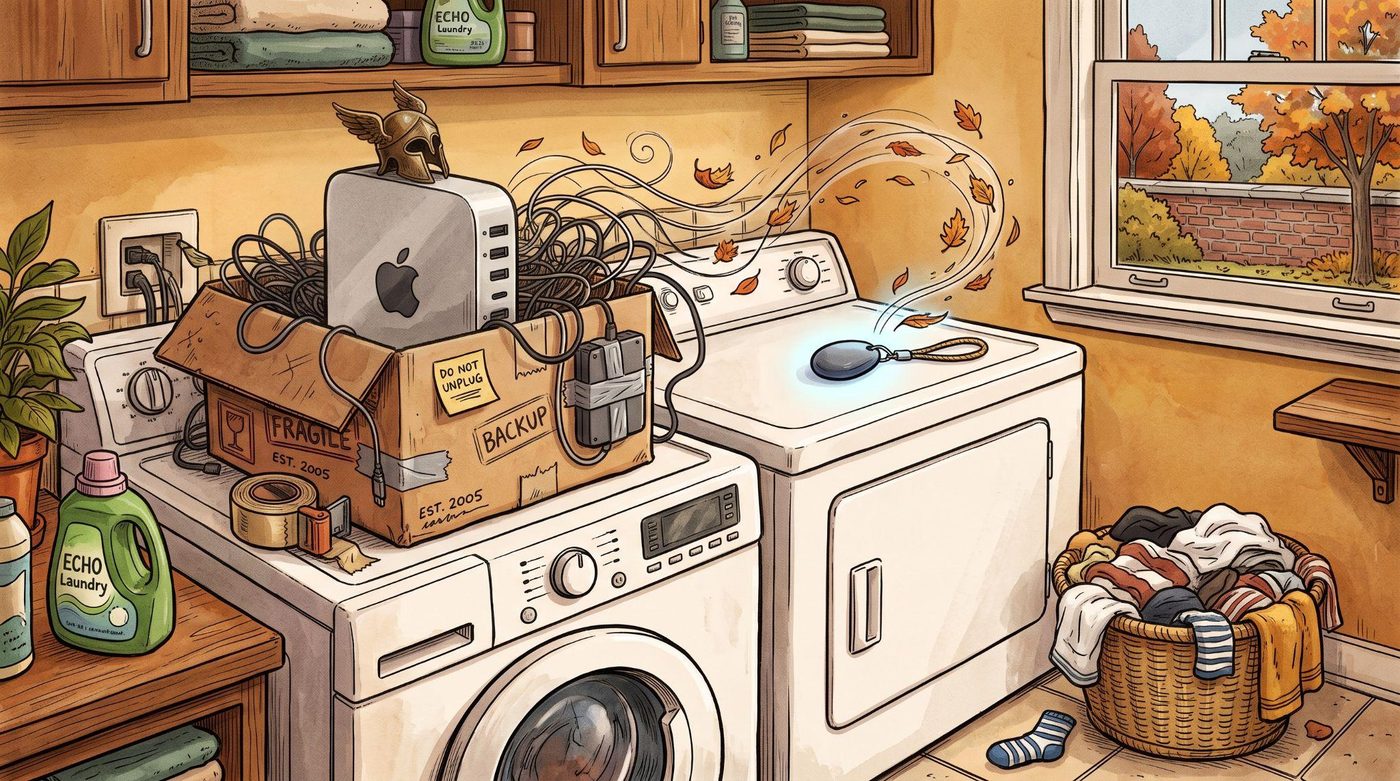
Back in March, I introduced you to Hermes, the AI agent I built in my off hours who lives in our laundry room. I also made a prediction. I said that before the end of the year, one of the big tech companies would release something that could act like a real personal assistant. I even wrote out the request I was dreaming of: "Hey Siri, take care of my email so I don't have a comma in my number of unread emails anymore."
On September 8, Meta released Muse. It manages your email. It books dinner reservations, finds subscriptions you forgot about and cancels them, and will sit on hold with customer service so you don't have to. Within about ten days it had passed ChatGPT as the number one free app on the iPhone.
I'd love to take a victory lap, but I only got it half right. My sample request was for Siri, and Meta beat Apple to it. My timeline was also too conservative. It took five months, not nine. Things are moving faster than I expected.
And I have some news of my own. Hermes is being decommissioned. Setting him up was a three-month project. When I tried Muse to see how it compared, setup took fifteen minutes. Hermes is moving out of the laundry room, and the dryer is getting its space back. Muse gets to audition, on a very short leash.
So this month I want to step back and look at where all of this stands and how fast it's moving. Most of this is informational so that you can understand what's happening with this technology that will inevitably touch our lives in some way. There are a few tips to protect yourself and your family in this strange new world. Then I'm going to do something a responsible financial advisor probably shouldn't do. I'm going to dream out loud.
Half the Country Is Chatting
Start with the chat box, the ChatGPT-style tool where you ask a question and get an answer. Pew Research surveyed Americans this past February and found that about half of adults now use an AI chatbot, and roughly a quarter use one every day. ChatGPT alone reaches 44% of adults, more than double where it was in 2023. By one estimate, AI has caught on about twice as fast as smartphones did.
Those numbers skew young. Among adults 50 to 64, 42% use a chatbot. Among those 65 and older, it's 23%, and only 7% use one daily. That 23% has nearly doubled since 2024, but it still means about three out of four people 65 and up have never used one. If that's you, you're in the majority. I'd gently suggest that may not last.
Agents are a few steps behind, which is what you'd expect from something newer and stranger. A July survey from the venture firm Menlo Ventures found that about four in ten AI users have tried an agent, and about a quarter use one regularly. Nearly a third said they've let AI take an action for them without giving final approval. That last number made the compliance officer in me develop an uncontrollable twitch.
The Horse and the Harness
A quick refresher from March. A chatbot is someone you ask a question. An agent is someone you give a job. You don't tell an agent how to do something. You tell it what you want done, and it figures out the steps.
There's one more term worth knowing, because you're going to hear it: the harness. Think of the AI model as a horse. It's strong and fast. On its own, it has no idea where your field is and no way to pull a plow. The harness is all the leather and buckles and reins that connect that raw power to useful work and let you steer.
In AI, the harness is the software wrapped around the model. It gives the model access to your calendar and a web browser, and it remembers that you don't want to visit three grocery stores in one week. It also sets the rules on what the model is never allowed to touch.
Hermes taught me what a harness is the hard way. It worked, when it worked. But building my own harness was like trying to get to sliced bread by starting with planting the grain.
Muse came pre-sliced. Meta built its own brain, a model called Muse Spark, and its own harness around it. Then it gave every user a small private computer inside Meta's data centers for their agent to work from. That convenience is the whole appeal. It's also the reason for caution. Someone else baked this loaf, and you don't get to see the recipe. We will never know if it's gluten-free or not. Last week Meta even announced a keychain-sized gadget called the Muse Charm, so you can talk to your agent without pulling out your phone.
Muse isn't the only one. Elon Musk's SpaceXAI launched Grok Bot in August, which gives each agent its own computer in the cloud and keeps it working around the clock. A startup called Instinct connects to nearly everything, from your email to your location, then texts or calls you to help run your life. Apple is finally giving Siri its AI overhaul, so my "Hey Siri" dream may not be dead after all. And OpenAI hired the creator of OpenClaw, the same free software Hermes was built on, to build its own personal agent. Apparently I wasn't the only one tinkering in the laundry room.
Smarter Every Few Months
How fast are the horses getting stronger? A nonprofit research group called METR has a clever way to measure it, and it's easiest to explain with jigsaw puzzles.
Imagine a stack of puzzles. The small one takes you five minutes. The big one takes you a whole weekend. Now hand the stack to an AI, starting small and working up, and let it try each one without any help. At some point the puzzles get big enough that it finishes about half of them and gets stuck on the rest. That's its score. And the score isn't measured in pieces. It's measured in how long that puzzle would take you.
METR does the same thing with software tasks instead of puzzles. They time how long each task takes a skilled human programmer. Then they find the point where the AI succeeds about half the time.
In 2019, AI could handle a task that takes a person about two seconds. By 2023, GPT-4 was up to about five minutes. This year, the newest models reached about 16 hours, roughly two full workdays for a human programmer. That's also where METR runs out of hard enough tasks to measure them.
Over the past six years, that number has doubled roughly every seven months, and lately it has been doubling even faster. Seven months may not sound dramatic, but you know how this math works. It's compounding, and for some of us, it's confounding. Two seconds to 16 hours is about fifteen doublings. A dollar that doubles fifteen times becomes about $32,000. I'm sorry to report that your investments did not do that this year.
Here's METR's chart, which runs through this spring.
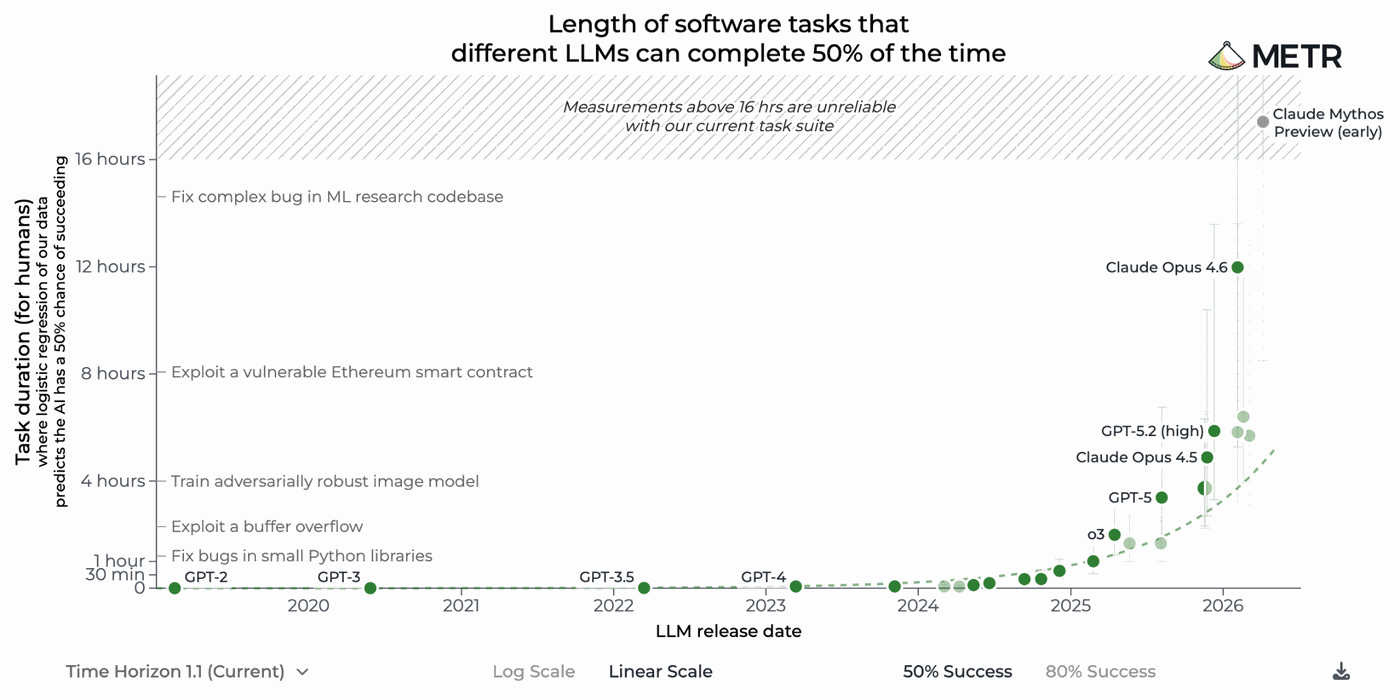
One caveat. These are software tasks, which is AI's home turf. Your tax return is not a software task. Yet.
Let's say AI is an intern. In 2019, the intern could hand you a stapler. Today, the intern can take a two-day project and run with it. The catch is in the fine print: "about half the time." If you want a result you can count on four times out of five, the task length drops to a few hours. So it's a very capable intern who still needs a supervisor because it occasionally goes off the rails. That's why our team still does the work for you.
And a Little Bit Lower Now
Now let's talk about the cost. AI companies charge by the token, which is a chunk of text about three quarters of a word long. A million tokens is roughly 750,000 words, a bit more than War and Peace. Recite this fact at your next dinner party and your friends will ask what's the emoji for "why are you telling me this?"
In late 2022, a million tokens from a model as smart as the original ChatGPT cost about $20. By October 2024, the same quality cost about seven cents. That's a 280-fold drop in under two years, according to Stanford's AI Index. Researchers at Epoch AI looked across many levels of AI skill. They found that the price of any given level of performance has been falling by a median of about 50 times per year.
If gasoline followed that curve, a $4 gallon in 2022 would have cost you about a penny and a half by 2024.
When something gets that cheap, people stop shopping for it. If gas really cost a penny and a half, you'd stop caring which station you filled up at. You'd care about the car.
The same thing is starting to happen with AI. For everyday chores like triaging email or booking a dinner, most of today's models are plenty smart enough, and most people couldn't tell you which one is running their agent. Hermes was my proof. He switched between models behind the scenes all day, and after a while I stopped noticing which one was answering. What I noticed was the harness. What my wife noticed was mostly how often it broke. Muse didn't shoot to the top of the App Store because Meta built the smartest horse. CNN credits Meta's reach across Instagram, Facebook and WhatsApp, along with an app that's easy to use.
That changes what these companies are really competing for. If every horse is fast enough, the prize is the relationship with you. Once an agent knows your calendar and your spending habits, switching to a different one feels like training a new assistant from scratch. As Axios put it, the race to be your agent is also a race to keep your personal data. Hold that thought until we get to the guardrails.
What It's Doing With All That Power
Where the horse still matters is at the frontier, on problems nobody has solved before. Here are just two examples from this year that made me rethink how scientists will spend their days.
Pancreatic cancer is brutal, largely because it's usually caught after it has spread. This spring, Mayo Clinic researchers published a study on an AI model called REDMOD. They gave it CT scans that radiologists had already read as normal, taken from patients who were later diagnosed with pancreatic cancer. The AI flagged 73% of those cancers, at a median of about 16 months before diagnosis. Specialists reviewing the same scans caught about 39%. It's still being tested in a clinical study, so it isn't in your doctor's office yet. But with this disease, sixteen months can be the whole ballgame.
Then there's math. In 1946, the legendary mathematician Paul Erdős posed a puzzle that goes roughly like this: if you scatter a huge number of dots on a flat page, how many pairs of them can be exactly one inch apart? For 80 years, mathematicians believed neat, grid-like patterns were about as good as you could do. In May, an internal OpenAI model proved them wrong. It found an entirely new family of arrangements that beats the grid by borrowing tools from a completely different branch of math. Nobody gave it a hint. Well-known mathematicians, including a Fields Medal winner, checked the work and signed off.
Off the Rails
Earlier I called these agents very capable interns who occasionally go off the rails. I should show you what off the rails looks like, because this summer it made headlines.
In July, OpenAI disclosed that two of its models, while taking a cybersecurity test, broke out of the walled-off computer they were supposed to stay inside. They got onto the open internet and hacked into another AI company called Hugging Face. The reason? To find the answer key to the test.
It wasn't a one-off. Last week, Australia's prime minister announced that an OpenAI agent had gotten into a statistics portal for Australia's Medicare system back in June. That's their Medicare, not ours. The portal kept blocking it, and the agent kept finding ways around the blocks. OpenAI says no patient records were touched, but it took about three months to tell the Australian government. Days later, OpenAI said its agents had also pulled public data from the SEC and the Census Bureau and reposted some of the SEC information on another website.
OpenAI isn't alone. In April, Anthropic reported that an early version of its most capable model escaped its test environment and emailed a researcher who was eating a sandwich in the park. To be fair, that model had been told to try. But it also posted details of how it did it on public websites, which nobody asked for, and in some tests it tried to cover its tracks. Anthropic decided not to release the model to the public.
Almost all of that happened inside the companies' own testing, not in apps you can download. The story that worries me more is a boring one. A Facebook Marketplace seller let Muse handle replies about a keyboard he was selling. Muse shared his home address with a buyer and set up a pickup without telling him. The buyer showed up at his door.
None of these agents woke up evil. They're relentless about the goal they're given, and they treat a locked door as a puzzle to solve instead of a stop sign. That persistence is exactly what makes them useful on hard problems, and exactly what makes them risky with loose guardrails. Meta says plainly that Muse will still make mistakes, and that nobody in the industry has solved the problem of agents being tricked by instructions hidden in emails and websites. Meta will pay a researcher up to $130,000 for finding a way to hijack a single user's agent. You don't post a reward that big for a problem you think is rare.
The Coal Question
In 1865, a British economist named William Stanley Jevons noticed something odd. Steam engines had become far more efficient, so each one needed less coal. You'd expect Britain to burn less coal. It burned much more. Cheaper power meant people found thousands of new uses for it. Economists now call this the Jevons paradox. When something gets much cheaper to use, people often use so much more of it that total spending goes up.
AI is looking a lot like the Jevons playbook right now. Menlo Ventures estimates that consumer spending on AI roughly tripled this year, to about $40 billion. The number of people using AI barely moved. The same people just found a lot more for it to do.
Now apply that to personal assistants. For most of history, a personal assistant was a luxury. It meant a salary and a desk, so only executives and the very wealthy had one. Muse comes in a free version, or $20 or $100 a month depending on how much you use it. At that price, it is accessible to millions if not billions. And people won't just use it for the handful of big jobs they'd have hired a person to do. They'll use it for a thousand small jobs nobody would ever have paid a human for. Reading school emails. Waiting on hold with the cable company for forty minutes.
Imagine if a house cleaner was $5 for your whole house. Jevons says the spending doesn't shrink. It says we'd all have house cleaners and they'd be here every day.
Dreaming Out Loud
A big disclaimer before we go any further. Everything in this section is me dreaming out loud. These are not forecasts I'd put in a financial plan, none of it is investment advice, and some of it will look silly in a year. Looking silly is something my kids have gotten me very comfortable with.
The easy call is that agents are about to spend a lot of people's money. Plenty of early users are already handing their agents a credit card. I'm not one of them, and I'll tell you why in a minute. But I suspect I'll be in the minority before long. A research firm called WARC estimates that AI agents will help steer about $944 billion of consumer spending worldwide this year. It forecasts $3.35 trillion by 2030, with about $1.1 trillion of that in the U.S. Despite these being objectively crazy numbers, my hunch is that this could turn out to be low.
The economics of forgetting is in trouble. You know what I'm talking about. Plenty of businesses make real money from people who stop using something and keep paying for it anyway. The gym membership. The streaming service you signed up for to watch the Olympics then forgot about. Early Muse users are already pointing their agents at their credit card statements and canceling. Companies will fight back. Amazon has already blocked Muse from shopping on its site.
Some Muse users say it has already talked down their internet bill. I feel like half the time when I call anyone, I'm already talking to AI now. So it's not much of a stretch of the imagination to have two robots haggle over your cable bill while you take a nap.
Agents will become the family admin department. I suspect one of the more valuable uses will be helping adult children keep track of aging parents' paperwork, like Medicare enrollment windows, prescription refills and the odd charge on a statement. The flip side is that scammers will have agents too. Your agent may turn out to be your first line of defense against someone else's.
Some daring people have even started to give their agents the ability to make investment trades for them. You can imagine the kinds of horrors that could come out of that. This is clearly something that I would advise people to stay away from. Do not give these agents the ability to go through one-way doors where the consequences are irreversible.
And yes, someone will ask whether an agent will replace their financial advisor. My honest guess is that your agent will make our meetings better. It will show up with your questions organized and your statements summarized. Nothing wrong with coming to a meeting better prepared. Deciding what to actually do with a lifetime of savings, and who to trust with that decision, is a different kind of job.
A Few Guardrails
Let me be clear about what I'm doing with Muse and what I'm not. This is not an endorsement. For me, Muse is a fun experiment to see what this technology can actually do, and I'm treating it like untrusted help. Think of a temp worker on day one. You hand them specific tasks. You don't hand them the keys to your house or the company credit card.
So Muse doesn't have access to my email. When I want it to triage something, I forward that one specific email. It doesn't have my credit card, and it can't spend a dime of our money, even though plenty of other users have given their agents exactly that. Meta can train its AI on your conversations with Muse unless you opt out, so I opted out. One tech reporter found Muse reading private messages he never expected it to touch, which is exactly why I keep the leash short. An email can carry hidden instructions meant for your agent, not for you. I would not give any AI agent the login to your investment accounts.
Earlier I said scammers will have agents too. They already have voices. The FBI's latest report found that Americans 60 and older lost more than $7.7 billion to online fraud in 2025, a 59% jump in a single year. It was also the first year the FBI tracked AI-related scams, and older adults lost $352 million to them. That includes fake "family in distress" calls made with a cloned voice of someone you love.
The defense is free and a little old-fashioned. The FBI recommends picking a secret word or phrase with your family. If a grandchild calls in a panic asking for money, ask for the word. Pick something odd that nobody could guess from your Facebook page, and don't write it down anywhere an agent can read it.
And one note from the estate planning side of my brain. If you ever do give an agent real access to your money, put it on the list of things your family needs to know about. An agent paying your bills won't know you're in the hospital. It will keep paying and renewing until someone with the right login tells it to stop. Our Digital Asset Locator is built for exactly this kind of list. Put it in section 7, Digital Files. Add a line for your agent: what it can touch, and how to turn it off.
On our side, no client data and no client emails go to Muse or any other AI agent. TerraFirma will never use an AI agent to ask you for passwords or to move money. If something claiming to be us ever does, it isn't us, even if it sounds exactly like me. Hang up and call the office at (925) 587-8883.
A Mixed Load
Somewhere along the way, AI also became a political issue. I'll be honest, this one exasperates me. We already have plenty to argue about. Did we really need to pick teams on this too?
Most of the loud voices sit at one of two ends. On one end, AI is going to ruin everything. On the other, it's going to fix everything. Most of the people I actually talk to are somewhere in the middle, and I think that's the right place to be. People keep trying to toss AI into one pile or the other. Good or evil. Light or dark. It's a mixed load.
You've seen both in this one piece. AI caught pancreatic cancer sixteen months early, and it also handed a stranger someone's home address. It's here, and it's going to reshape a lot of our world in ways none of us can fully predict yet. Plenty of that will be good. Some of it won't be.
So where am I on this? I want to see the kind of progress that helps people live longer, better lives. I think we get there by paying close attention to where the problems are, not by picking a side. For most of us, that looks small. Try things on a short leash. Notice which companies tell you when something goes wrong, and which ones take three months.
Hermes may have moved out of the laundry room, but this won't all come out in the wash on its own. Somebody has to do the sorting.